Build security
that remembers.
The foundation beneath every security engagement — engineered to preserve everything your organization learns.
What organizations lose
You already paid for this knowledge.
Every year, organizations spend millions learning about their own security — penetration tests, red-team exercises, incident response. Much of that knowledge becomes difficult to retrieve, connect, or reuse.
Every engagement begins with optimism. Every report promises change. The engagement ends, the findings are filed, the team moves on.
Twelve months later, the same findings return.
This phenomenon has a name: knowledge decay.
Organizations don’t have a security problem.
They have a forgetting problem.
Imagine a security program where every engagement made every future engagement smarter.
There is a name for the fix
Security Knowledge Intelligence
noun
The discipline of transforming years of organizational security evidence into enduring institutional knowledge.
Felswerk exists to make Security Knowledge Intelligence possible.
Why this is finally possible
The economics have changed.
The knowledge was never the problem. The labor was. Turning a ninety-page pentest into structured knowledge, linking it to three years of prior findings, keeping all of it current: that was months of expert work no team could spare.
Machine-assisted extraction and retrieval reduce that burden. Combined with provenance, human review, and source traceability, they make longitudinal security knowledge practical to maintain.
What your organization learns can now outlast the engagement that produced it.
How knowledge compounds
Engineered, not accumulated.
Capture
Evidence becomes structure. Pentests, red-team operations, and incident records are parsed into findings, techniques, and assets — not pages.
Connect
Observations become relationships. Every finding is connected to the frameworks your teams already use — and to everything your organization has learned before.
Compound
Knowledge accrues value. Every new assessment strengthens the last — coverage, exposure, and progress are measured across years, not engagements.
Decide
Memory becomes action. The record becomes ranked priorities, executive narratives, and decisions your organization can defend.
Security doesn’t improve because reports exist.
It improves because knowledge compounds.
Felswerk is built around one idea: every engagement should strengthen every future engagement. We call it knowledge compounding.
What Felswerk actually does
From findings to foundations.
- Ingests penetration tests
- Connects findings across years
- Maps techniques to ATT&CK
- Tracks recurring weaknesses
- Preserves institutional knowledge
- Generates executive narratives
What actually happens
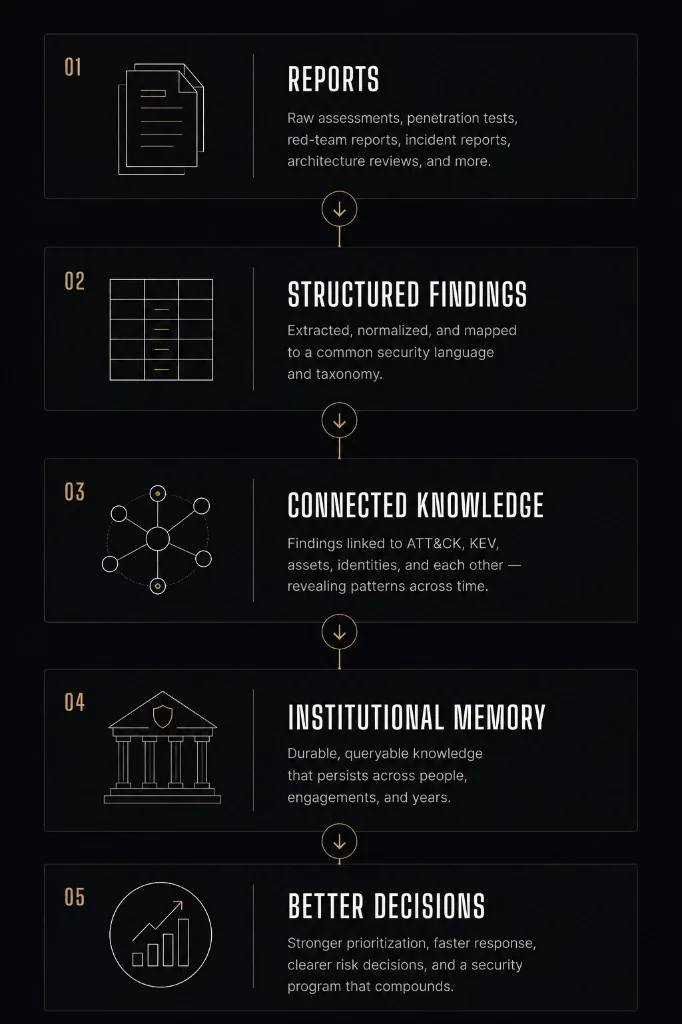
The result
Own what you paid to learn.
Every year, organizations buy security knowledge. Then they throw it away.
Felswerk helps preserve that knowledge as an enduring organizational asset.
Security programs don’t improve because they buy more assessments. They improve because they stop forgetting what they’ve already learned. The outcome is institutional memory.
Without Felswerk
- Reports
- PDFs
- Consultants
- Tickets
With Felswerk
- Institutional memory
- Organizational knowledge
- Continuous improvement
- Executive clarity
Why we build
Security knowledge should endure.
Every assessment should strengthen the next. Every lesson should become institutional. We wrote down what we believe — it fits on one page.

Build on bedrock.
Every security engagement teaches your organization something. Felswerk is built to reduce the need to relearn what it already knows.
Our name evokes a fortification engineered directly into bedrock. That is how we believe organizational knowledge should be built.